Gratitude.ME | Michael Eddy
This blog post is taken from Michael Eddy’s Gratitude.me project, created during a residency at Sporobole as part of the Chantier ia.
Q: Sorry—can we rewind a second? I don’t understand why you wanted to make a fake patent registration.
A: This is not a fake patent registration. It is a potentially real patent registration.
Q: Well why didn’t you want to make a real patent?
A: They cost thousands of dollars. This is an art project and I don’t expect to get any returns from my invention.


Q: Oh, it’s a fake patent? It’s not a serious invention, in other words?
A: No, it is potentially a real patent. I was thorough about imitating the formal conditions and language of such a document. And the invention is good, I stand by it. But have you seen what else is on the Canadian Patent Database? [giggles]
Q: I don’t know what’s so funny about the Canadian Patent Database.
A: Come on, people patent the dumbest stuff. Specific shapes for popsicles, for example. Patents that are super complicated only in order to fill up the patent description with specificity. Half the stuff in that database is only a title: no abstract, no description, no claims or even representative drawings. Like the idea of an idea. You don’t find that funny?
Q: I don’t think it’s very smart to belittle the Canadian Patent Database. You don’t sound serious about intellectual property. Why did you put so much effort into this document, then? Sigh. You know what, go on, rewind again, tell me about your invention, if it’s so “good.” But keep it brief.
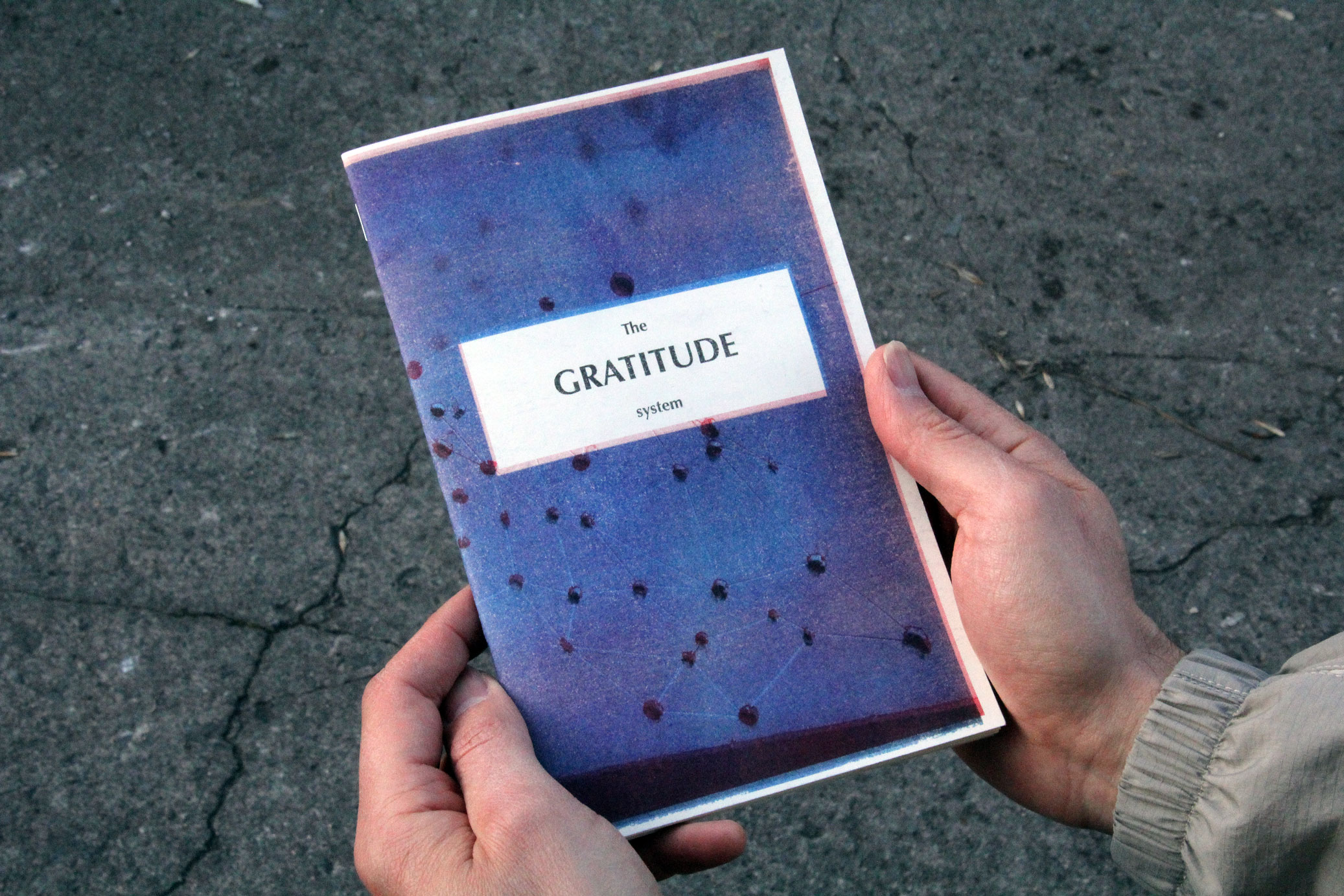
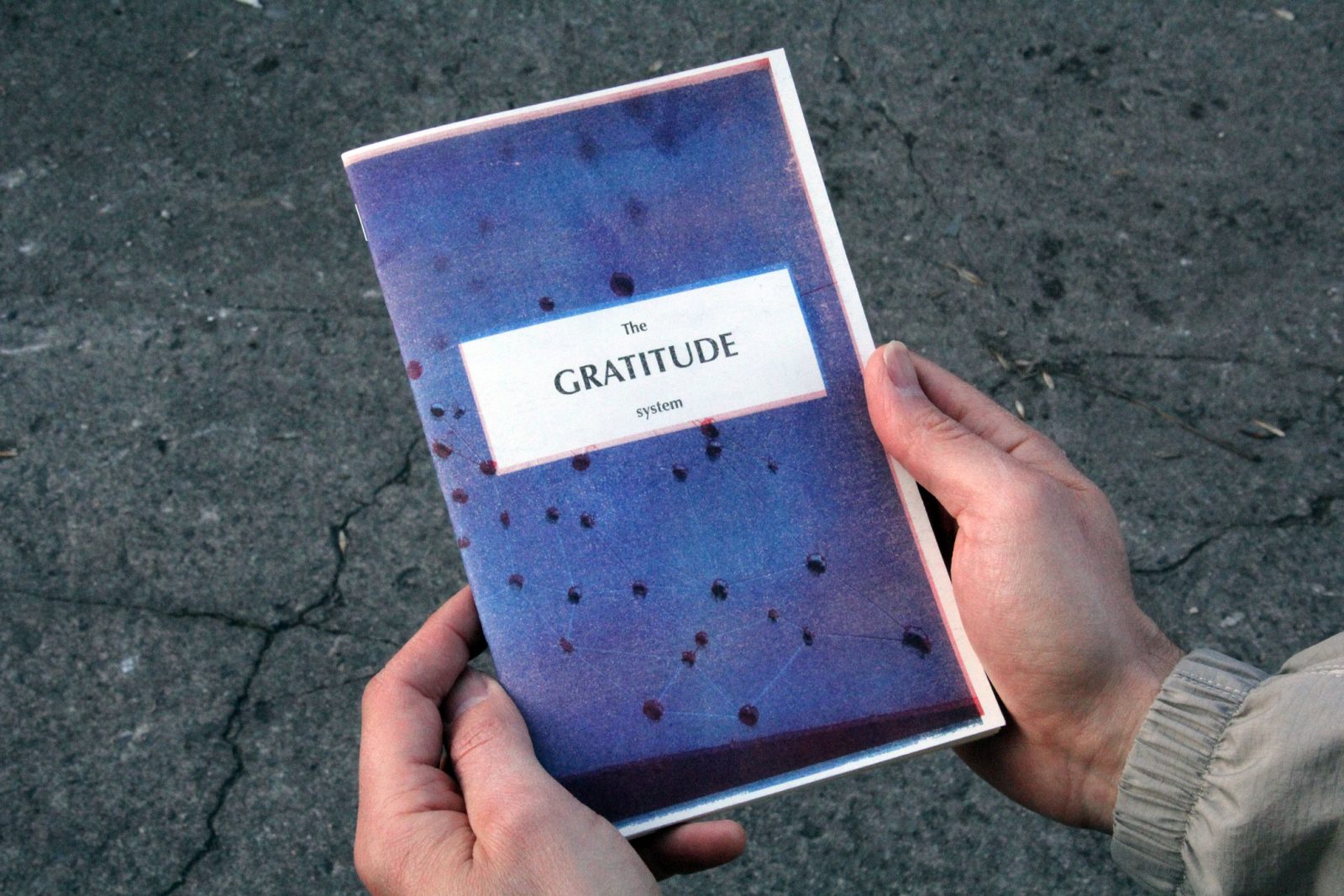
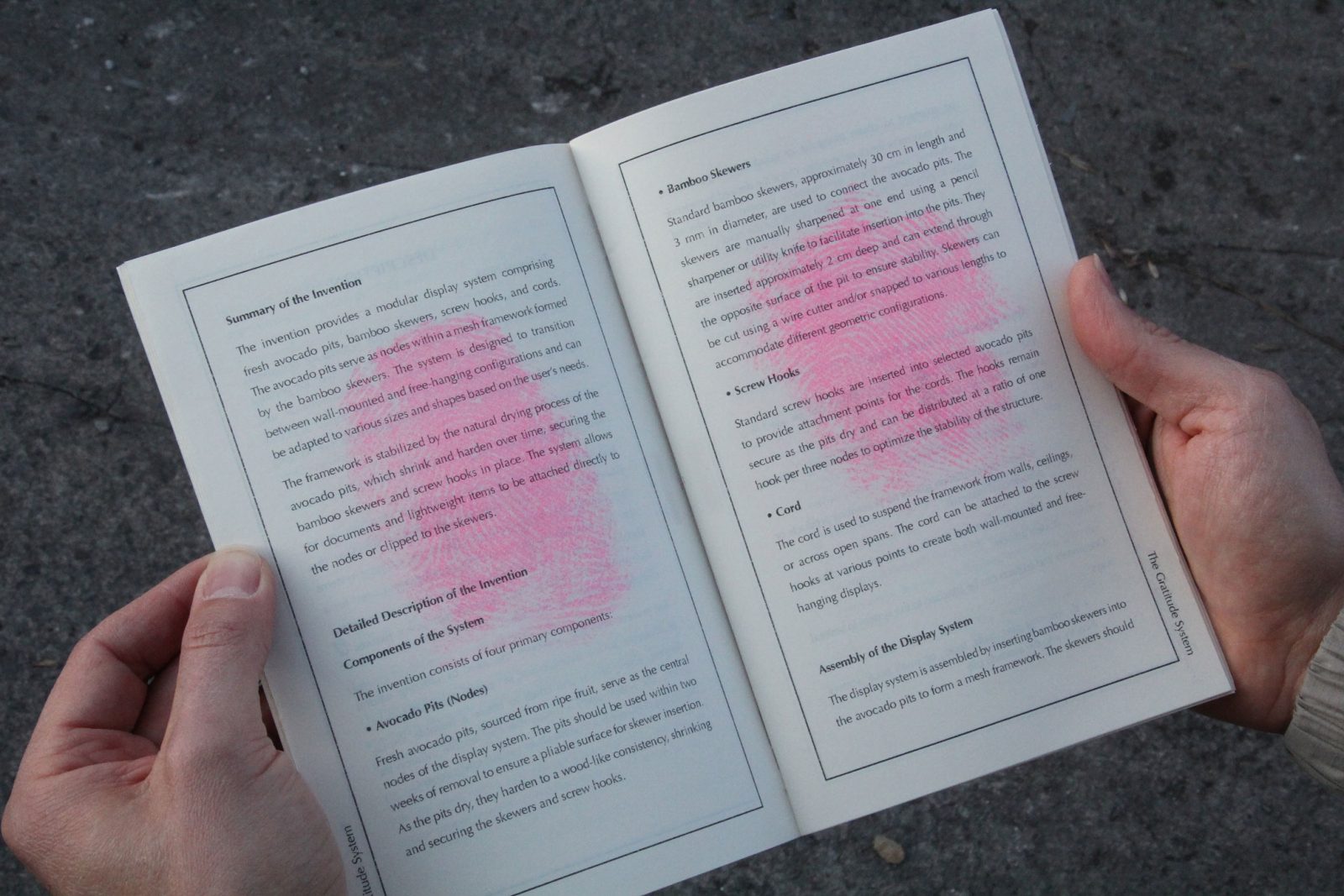
A: Okay, it’s simple, my invention is a document-hanging system composed of 4 components: avocado seeds, bamboo skewers, screw hooks and string. It’s all right here in this document in front of you.
Q: Yes, I see, and you call it the “Gratitude System.” You’ll have to explain what that means. But first, you claim that it’s easy and sustainable. But does it really have a use? Remember, you are under oath.
A: Yes, compared to other document-hanging systems like temporary walls, cork boards on chains, sandwiched plexiglass with airplane cable, or even, say, projectors and acrylic screens, the Gratitude System is easy, cheap, flexible, very lightweight, largely disposable, it’s all in the document in front of you…

Q: But to what end? Do you expect people to reproduce your system, to wit, for a trade fair? Or an exposition of children’s drawings in a shopping mall? Or newspapers at a library? i.e., is your system truly practical as you claim?
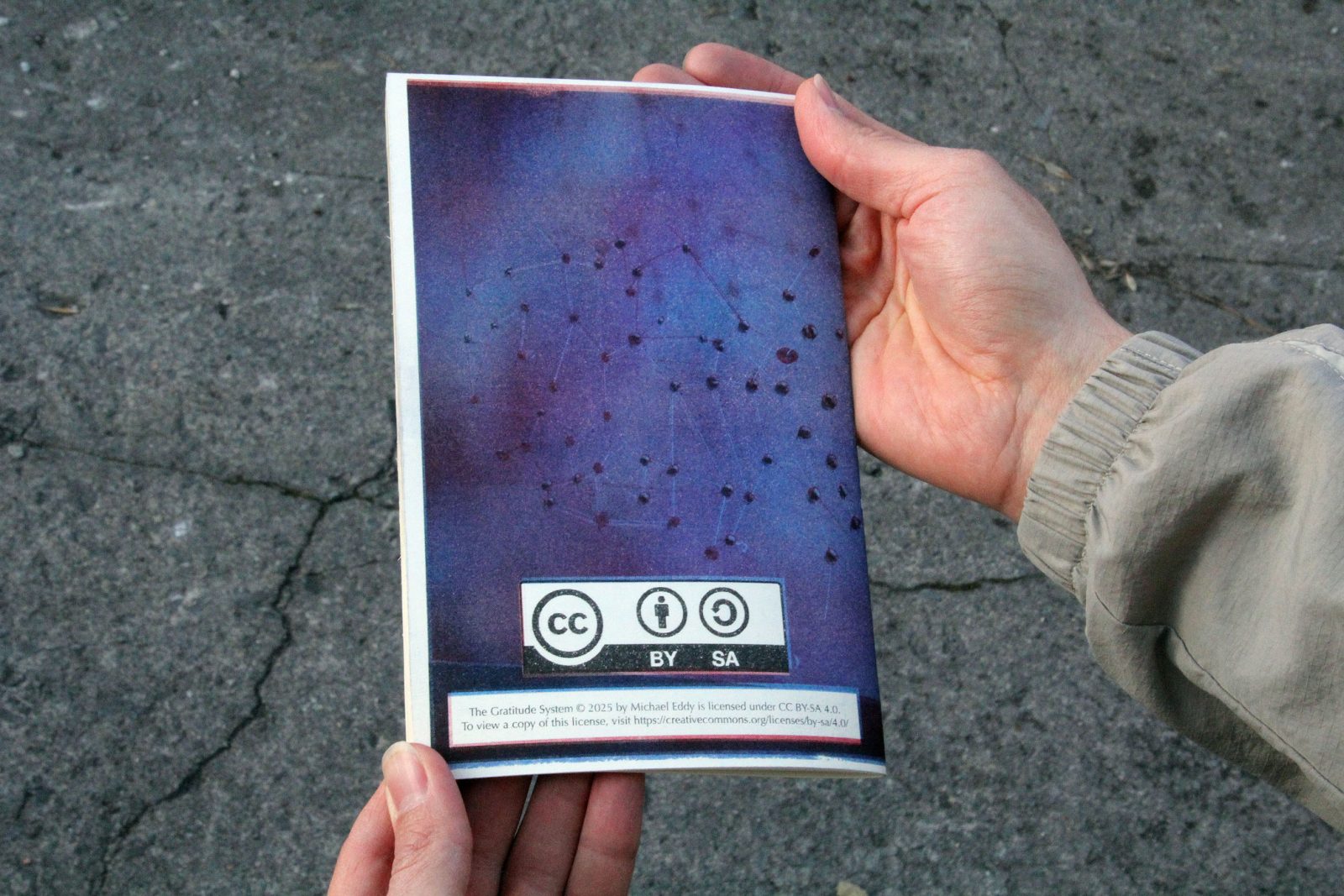
A: It is. I will use it to exhibit the documents pictured here in an exhibition, if I could ever get someone to take me seriously. But anyone can use it. That was the purpose of this document in front of you. To publicize the invention. And look on the back cover—that’s right, that logo means I have licensed the contents of this zine describing the invention under CC BY-SA, which stands for “Creative Commons Attribution-ShareAlike.” It allows others to distribute, remix, adapt, and build upon a work, as long as they credit the original creator and license their new creations under the same terms. That last sentence was appropriated from the creative commons website.
Q: How many copies of this document, “the Gratitude System” are in existence?
A: Oh, about 32 or so.
Q: [rolls eyes] You don’t know the exact number?
A: Well, I printed it on a risograph machine. Risographs are difficult, they mess up a lot. Let’s say there is an edition of 29, and then there are 3 with slightly different covers.
Q: That’s not very many. Wouldn’t it have made more sense to post an Instagram story or something? What is your follower count, I’ll bet it’s greater than 32. What was your point in using this awkward medium, and traveling all the way to Sherbrooke to use the EZ 220 U machine at Sporobole?
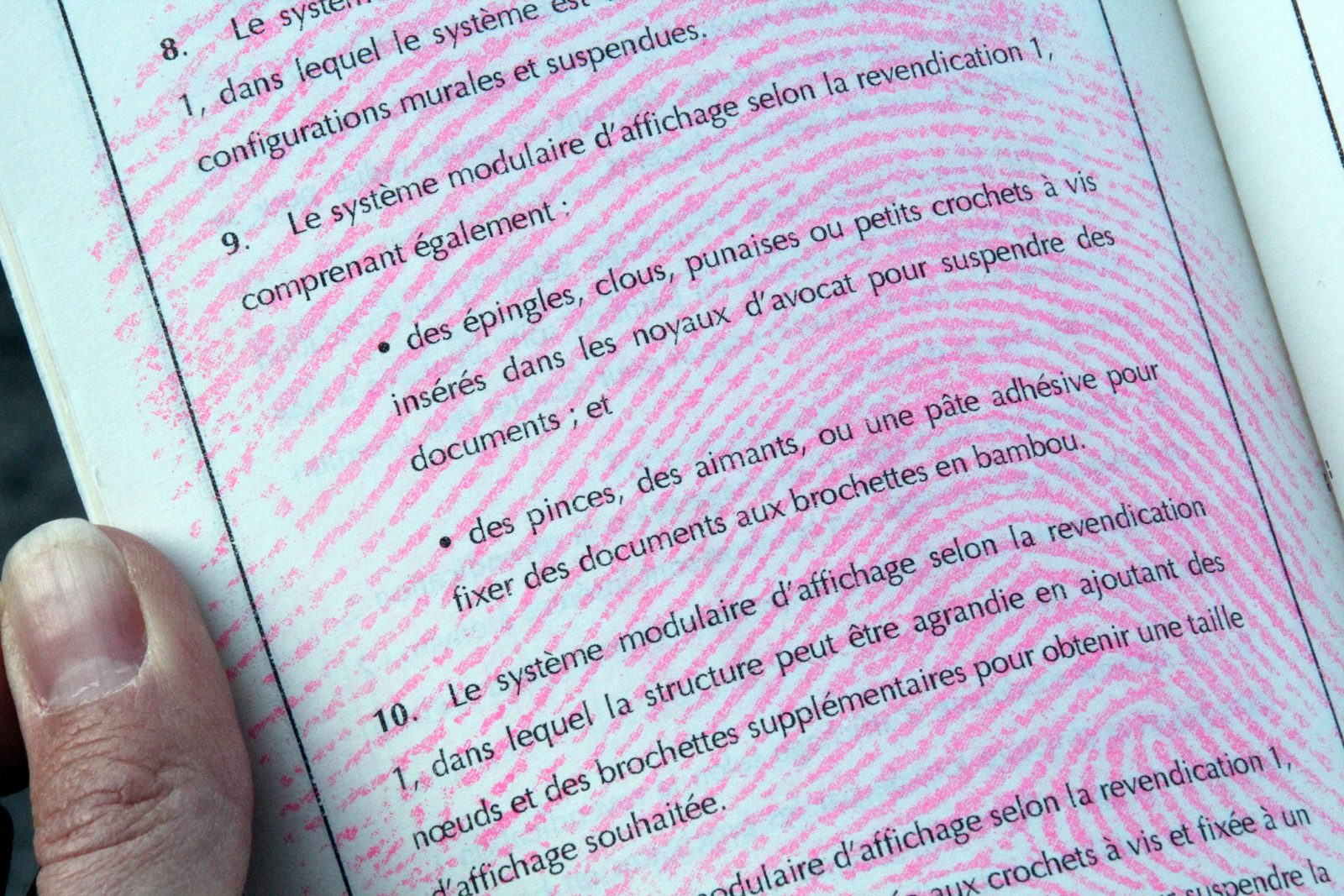
A: Ugh, I have no followers, I hate Instagram, I think it has fucked up a whole generation, but I digress—to me, a risograph also speaks of authenticity in this performative way. It’s an imperfect copy, it’s like a halfway-artwork, just in the way it looks and feels. And my point was to get this invention concept out in some public and arty way, also by exaggerating the authenticity —you see, it has large fingerprints watermarking the pages. And if you look closely, those fingerprints are watermarked by the Creative Commons License. Anyway, the idea was that if I couldn’t get the invention on the patent database, it could at least be kind of smuggled into the artwork-centric intellectual property regime: copyright. As soon as you put the artwork out there, you hold copyright over it. That’s cool, right?

Q: And yet you don’t seem to care about intellectual property. Or do you? Are you a hypocrite? It seems you’re being confusing on purpose. Rewind a second, rewind back to the title, what does the “Gratitude System” mean? Are you virtue-signalling, like pretending to acknowledge others in the conception of your invention? I see you have quoted a bunch of your friends in testimonies. I’d wager you’re a high-maintenance friend. Or do you expect us to be grateful for your invention? Or you’re referring to a non-monetary system of exchange?
A: Hm, sort of. But it’s more confusing than that. It’s very self-referential. If you’ll give me a moment, I’ll explain.
Q: I give you one moment.
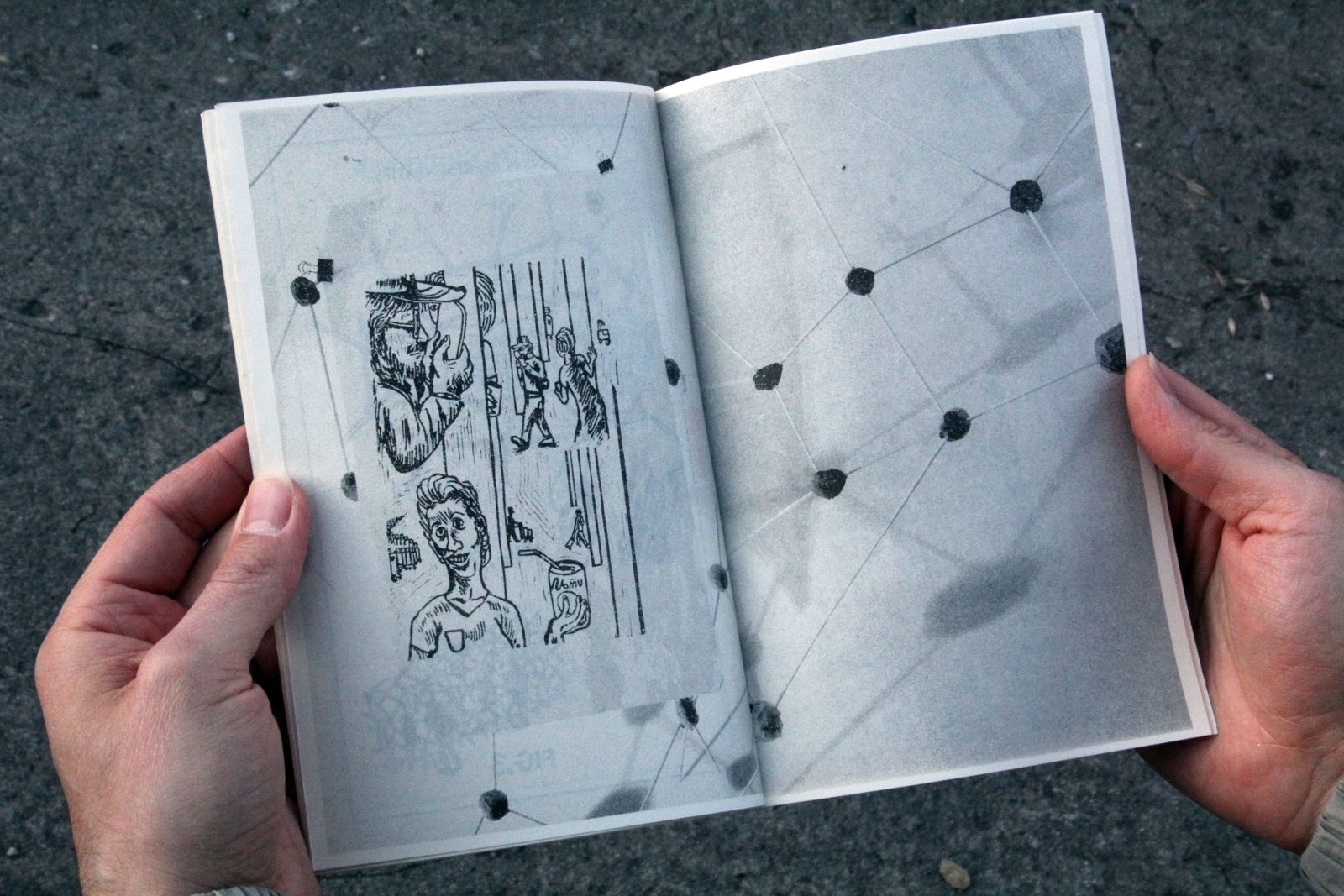
A: So, you see the documents hanging in the System?
Q: Barely, because of how smudgy your printing is.

A: Yes, those are linocuts, prints on paper. They are images I have been making, pages from a graphic novel I have been working on, called “Gratitude.” There you go.
Q: That’s it? That’s not complicated. I would even call it simplistic as far as explanations go.
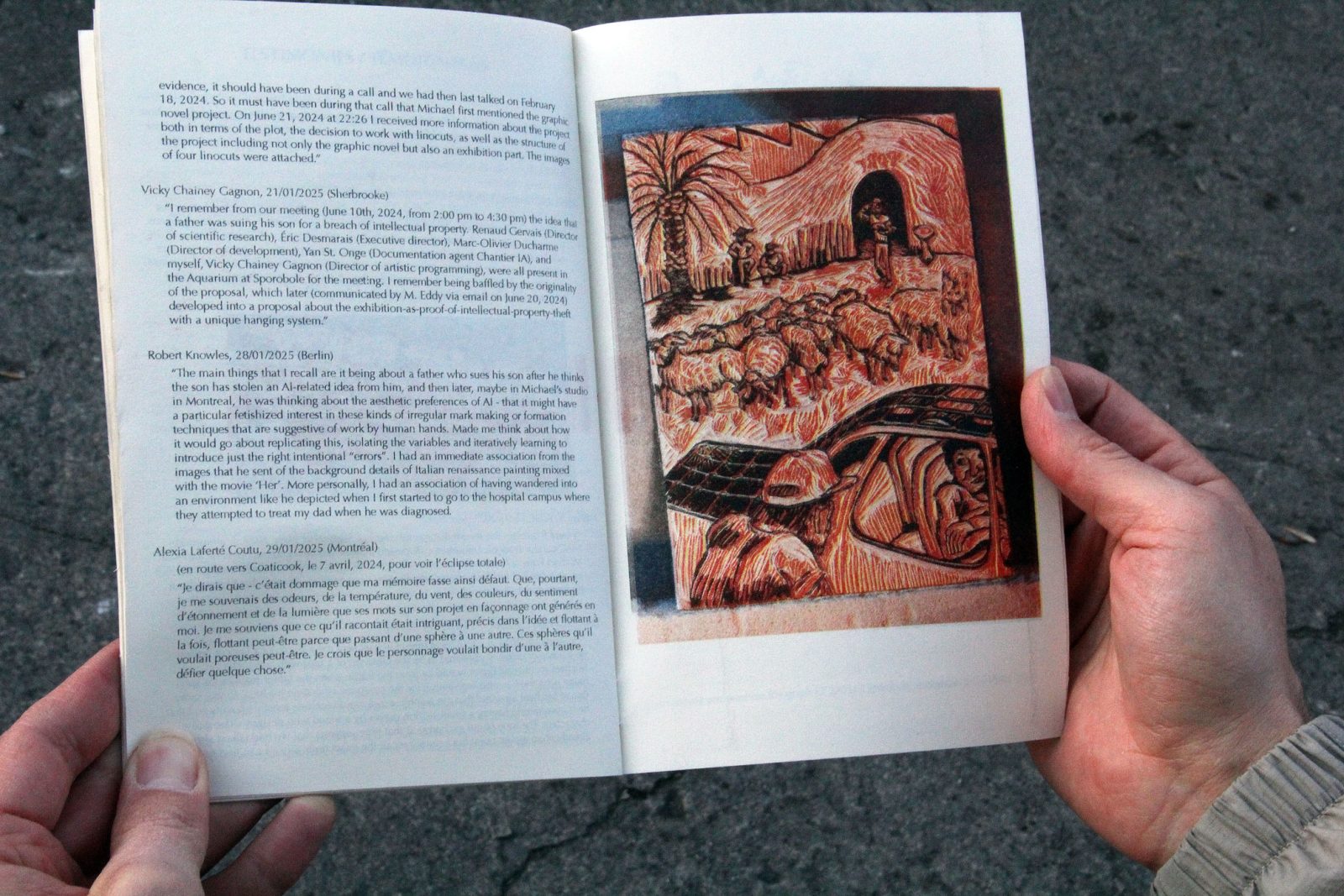
A: Well, sure, but the story in the graphic novel is about a near-future, where Artificial Intelligence manages societies across the globe. A man, let’s call him Father, is recounting an event to his lawyer: While running in a marathon, he had seen a billboard and become intrigued by it. It turned out it was advertising a sort of video game called “Subjectivity.” Learning more, Father is convinced that someone has stolen his idea for “Subjectivity,” and he wants to investigate it further. His lawyer asks if he has proof, but Father says the proof of his intellectual property is in the digital wallet that his ex-wife stole when she left him and fled Gratitude. He has to go get it from her.
Q: What does this mean, “she left him and fled Gratitude?” I don’t understand. Rewind. Please explain this, but your time is almost up.
A: Oh, Gratitude is the name of the zone where Father lives. The world has been sectioned off by different singularities existing in a multi-polar stalemate. Each singularity has its quirks. Gratitude is the vision of a liberal society with a universal basic income system, ecologically well-managed and high-tech, but its citizens must do creative work to keep the system from getting bored. If the system gets bored, the economy crashes, the automatons stop working. Father happens to be a successful creator within Gratitude. Then there’s a scam world, Versa, there’s a snob world, Eternitysia, there’s a zone where the singularity is only interested in exploring the language of nature and leaves the humans more or less alone, called Recta, or Verita, depends on the customs agents. That’s where the ex-wife fled to. I can’t say any more about the story or you’ll steal my ideas. But I also don’t know how it ends.

Q: This is one of those cases where someone is claiming to be writing a book, but really has no idea what they’re talking about. I’d wager you don’t even have a publisher. No exhibition venue, no publisher. You’re basically a raving madman using the least efficient techniques to get your scrambled message across. I’d ask you why linocuts, but I’ve heard enough. Your time is up.
A: No, look, I have proof! Gratitude is real! It’s in my patent registration document!
Q: Next!
A: Hold on, I can explain why I chose to do this in linocuts, it’s because the singularity likes handmade qualities! The singularity has no hands!
Q: Next! And can we get somebody who actually knows something about artificial intelligence in here? Next!
A: But didn’t you hear me? That’s what this is about! And I am not a graphic novel artist, do you understand? I am a concept artist! The project is a concept for a graphic novel!
Q: Next!
Learn more about the Gratitude.me project :
https://sporobole.org/en/creation/michael-eddy-chantier-ia-laboratoire/